 Catalogue Shom
boundaries
Type of resources
Available actions
Topics
Keywords
Contact for the resource
Provided by
Years
Formats
Representation types
Update frequencies
Scale
-
Title V of Volume IX of rural and sea fisheries laws defines the measures related to Overseas territories. Articles R951-14 and R953-5 in particular define for specific Overseas territories a limit located at 100 nautical miles from the in force baselines. Inside this limit, fisheries are limited to the ships registered in the ports of those Overseas territories, except dispensation allowed by State. Those restrictions are not applied to ships registered in the European Union which are traditionally fishing in those waters, as long as they do not exceed the fisheries effort which is traditionally applied.
-
Compilation of marine gravity surveys acquired in the Northeast Atlantic by Shom between 2001 and 2016. These surveys were compiled to perform a quantification of the error of the gravity anomaly models derived from satellite altimetry. This dataset represents more than 22,000 measurement points distributed in 9 ascii survey files sampled at 1 kilometer. The file’s format is as follows: longitude latitude Gravity_anomaly error line_label.
-
In the Law of the Sea, the continental shelf located beyond 200 nautical miles affects the seabed and its subsoil on which the coastal State exerts sovereign rights for purposes of exploration and exploitation of its natural ressources. In those areas, the wealth generated by the exploitation of the natural ressources are shared via the International Seabed Authority between the States which have signed UNCLOS (in particular with the developping States or the ones which do not have access to the sea). The outer limit of the continental shelf beyond 200 nautical miles is determined in compliance with the criterias of Article 76 of UNCLOS and notably by the examination of a submission deposited by the Coastal State to the Commission for the Limits of the Continental Shelf (CLCS). the outer limit of the French continental shelf beyond 200 nautical miles is the final result of the national program EXTRAPLAC after the adoption of recommandations by CLCS, the delineation of the attributed areas with neighbouring States if necessary and the publication by decree. The theme "Outer limit of the continental shelf beyond 200 nautical miles" gathers the limits of the extended continental shelf which has been recommended by CLCS and published by a decree of the French Republic.
-
The combined error grid of the SIO V31 gravity anomaly model (D. T. Sandwell, H. Harper, B. Tozer et al., Gravity field recovery from geodetic altimeter missions, Advances in Space Research, https://doi.org/10.1016/j.asr.2019.09.011) is computed with a method described in a paper submitted to Earth and Space Science (AGU). The model’s extension is North Atlantic.
-
The combined error grid of the SIO V31 gravity anomaly model (D. T. Sandwell, H. Harper, B. Tozer et al., Gravity field recovery from geodetic altimeter missions, Advances in Space Research, https://doi.org/10.1016/j.asr.2019.09.011) is computed with a method described in a paper submitted to Earth and Space Science (AGU). The model’s extension is North Atlantic.
-
The territorial sea extends from the baselines to a maximum distance of 12 nautical miles, calculated from the baselines. The State has full sovereignty over the bed and subsoil, surface and underlying water column and air space. Sovereignty shall not, however, hinder the right of innocent passage of which the ships of all States benefit in the territorial sea.
-
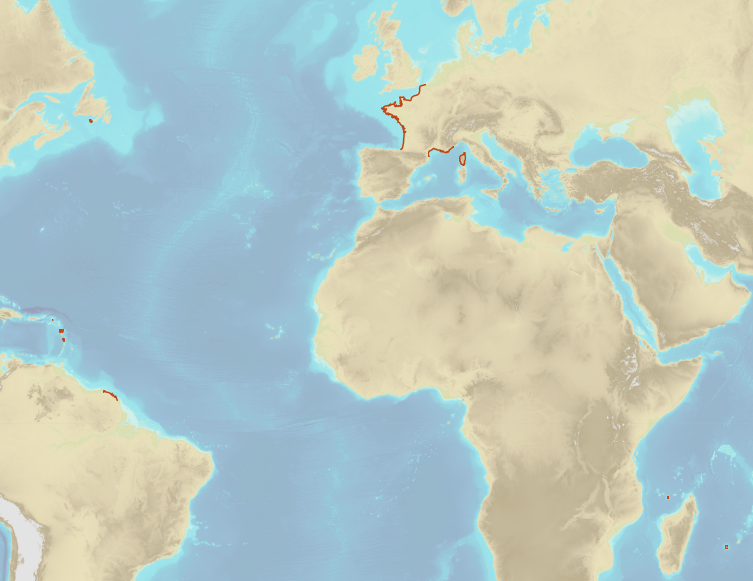
French Ministry of Culture / DRASSM – Shom The product "Limit of preventive archeology licence fee" contains the limits for the preventive archeology licence fee (1 nautical mile) as defined in the French Heritage Code. This limit is managed by the Department of Underwater Archeological Research (DRASSM) of the Ministry of Culture. This limit, defined by the Heritage Code at 1 nautical mile from the low-water line, permits to delineate the areas where the licence fee for preventive archeology at sea is applied. In Mainland France in the Gironde estuary, the limit for the preventive archeology licence fee is stopped by the crosswise limit of the sea as defined by the decree of 26 August 1857. In French Guiana, the limit for the preventive archeology licence fee is stopped in Maroni and Oyapock rivers by the crosswise limits of the sea respectively defined the order of 30 January 1991 and the order No 863 of 26 May 1986, until meeting the land boundary which delineates the rivers with the neighbouring States. The product "Limit of preventive archeology licence fee" is to use in addition to the digital product “Maritime Limits and Boundaries” of Shom (French: “Délimitations maritimes”) which represents the limits of the French maritime spaces of sovereignty or jurisdiction through the World. The product “Maritime Limits and Boundaries” (French: “Délimitations maritimes”) can be viewed on data.shom.fr (Maritime boundaries Category) and downloaded on the French national portal of maritime limits (https://maritimelimits.gouv.fr).
-
In compliance with Article 3 of UNCLOS, the outer limit of the territorial sea is located at 12 nautical miles from the baselines. It corresponds to the inner limit of the contiguous and exclusive economic zones. The objects of the theme "Outer limit of the territorial sea" result from Shom computations and are published by decree of the French Republic. Some of those limits are note published by decree yet.
-
French Ministry of Culture / DRASSM - Shom The product "Limit of preventive archeology licence fee" contains the limits for the preventive archeology licence fee (1 nautical mile) as defined in the French Heritage Code. This limit is managed by the Department of Underwater Archeological Research (DRASSM) of the Ministry of Culture. This limit, defined by the Heritage Code at 1 nautical mile from the low-water line, permits to delineate the areas where the licence fee for preventive archeology at sea is applied. The product "Limit of preventive archeology licence fee" is to use in addition to the digital product “Maritime Limits and Boundaries” of Shom (French: “Délimitations maritimes”) which represents the limits of the French maritime spaces of sovereignty or jurisdiction through the World. The product “Maritime Limits and Boundaries” (French: “Délimitations maritimes”) can be viewed and downloaded on the French national portal of maritime limits (https://maritimelimits.gouv.fr).
-
The United Nations Convention on the law of the sea (UNCLOS) introduced a new definition of the continental shelf which can extend “to the outer edge of the continental margin, or to a distance of 200 nautical miles from the baselines from which the breadth of the territorial sea is measured where the outer edge of the continental margin does not extend up to that distance.” Coastal States can thus have a continental shelf of 200 nautical miles even in the absence of a geomorphological continental shelf, and a continental shelf extending beyond that limit where the presence of certain geomorphological and sedimentary criteria have been recognized by the Commission on the Limits of the Continental Shelf (CLCS). The rights coastal State can exercise over the continental shelf are specified in Part VI of the UNCLOS. These rights are sovereign and exclusive over the seabed and subsoil, for exploration and exploitation of natural mineral, fossil and biological resources. The French authorities also hold competence recognized by the UNCLOS for: - construction, operation and use of artificial islands and installations; - marine scientific research; - issuing consent for the course of any pipeline; - issuing consent for the course of cables installed or used for exploitation of the continental shelf or of its resources.