 Catalogue Shom
boundaries
Type of resources
Available actions
Topics
Keywords
Contact for the resource
Provided by
Years
Formats
Representation types
Update frequencies
Scale
-
French Ministry of Culture / DRASSM - Shom The product "Limit of preventive archeology licence fee" contains the limits for the preventive archeology licence fee (1 nautical mile) as defined in the French Heritage Code. This limit is managed by the Department of Underwater Archeological Research (DRASSM) of the Ministry of Culture. This limit, defined by the Heritage Code at 1 nautical mile from the low-water line, permits to delineate the areas where the licence fee for preventive archeology at sea is applied. The product "Limit of preventive archeology licence fee" is to use in addition to the digital product “Maritime Limits and Boundaries” of Shom (French: “Délimitations maritimes”) which represents the limits of the French maritime spaces of sovereignty or jurisdiction through the World. The product “Maritime Limits and Boundaries” (French: “Délimitations maritimes”) can be viewed and downloaded on the French national portal of maritime limits (https://maritimelimits.gouv.fr).
-
The Regulation (EU) No 1380/2013 of European Parliament and Council of 11 December 2013, in its second paragraph of Article 5, authorises Member States to establish coastal waters along its coasts. Those areas enable member States to restrain fisheries to specific species to specific Member States following precise rules (quotas, limited fishery season). The description of the French coastal waters is established in Part 6 of Appendix 1. The coastal waters extend from 6 nautical miles from in force baselines to 12 nautical miles from in force baselines. Only portions of the French coasts are concerned.
-
The combined error grid of the SIO V31 gravity anomaly model (D. T. Sandwell, H. Harper, B. Tozer et al., Gravity field recovery from geodetic altimeter missions, Advances in Space Research, https://doi.org/10.1016/j.asr.2019.09.011) is computed with a method described in a paper submitted to Earth and Space Science (AGU). The model’s extension is North Atlantic.
-
The territorial sea extends from the baselines to a maximum distance of 12 nautical miles, calculated from the baselines. The State has full sovereignty over the bed and subsoil, surface and underlying water column and air space. Sovereignty shall not, however, hinder the right of innocent passage of which the ships of all States benefit in the territorial sea.
-
Compilation of marine gravity surveys acquired in the Northeast Atlantic by Shom between 2001 and 2016. These surveys were compiled to perform a quantification of the error of the gravity anomaly models derived from satellite altimetry. This dataset represents more than 22,000 measurement points distributed in 9 ascii survey files sampled at 1 kilometer. The file’s format is as follows: longitude latitude Gravity_anomaly error line_label.
-
The contiguous zone is adjacent to the territorial sea and may not extend beyond 24 nautical miles from the baselines from which the breadth of the territorial sea is measured. The coastal State may exercise the control necessary to: - prevent infringement of its customs, fiscal, immigration or sanitary laws and regulations within its territory or territorial sea; - punish infringement of the above laws and regulations committed within its territory or territorial sea.
-
In compliance with Article 33 of UNCLOS, the outer limit of the contiguous zone is located at 24 nautical miles from the baselines. The objects of the theme "Outer limit of the contiguous zone" result from Shom computations and are compliant with Article 10 of the French Order No 2016-1687 of 8 December 2016.
-
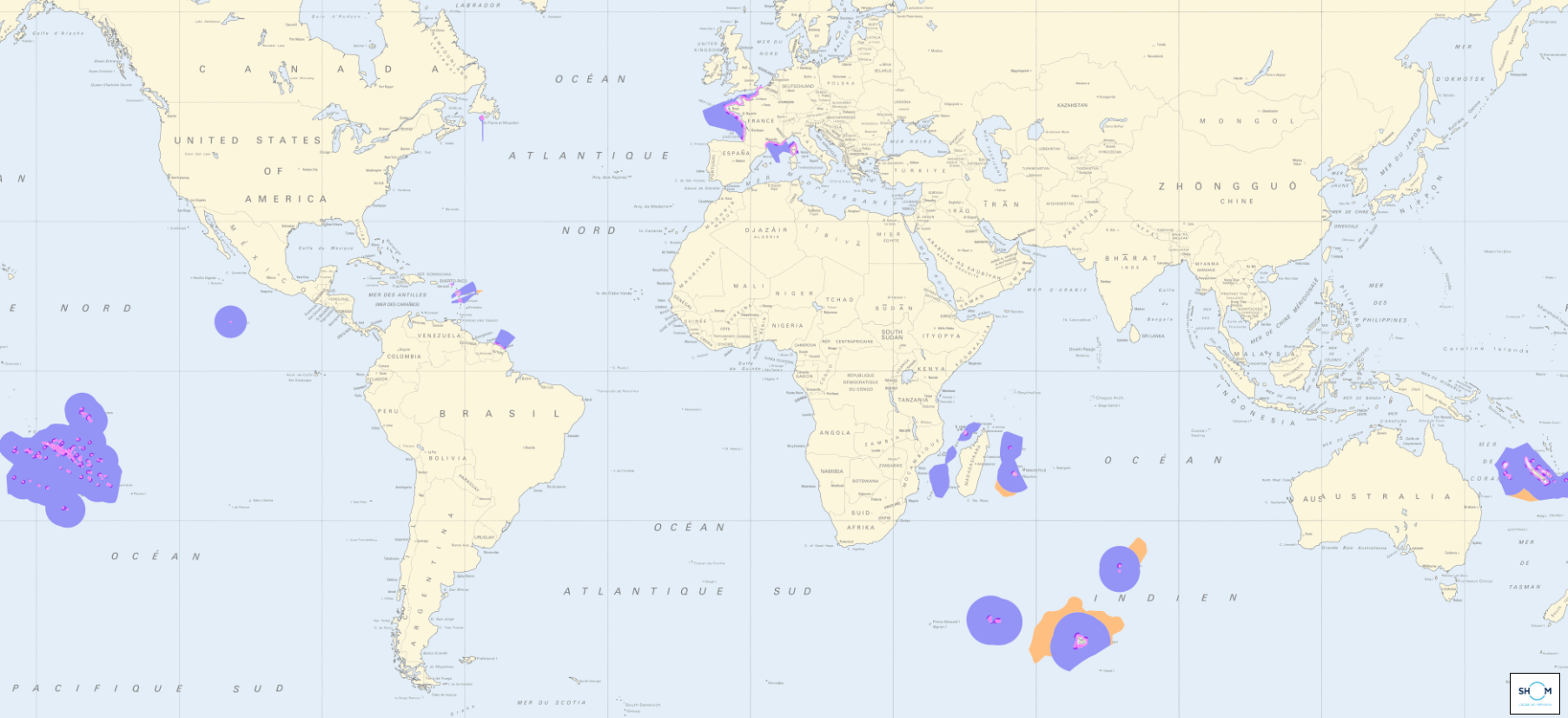
The "Sovereignty and jurisdiction maritime spaces of France" product contains the areas of sovereignty and jurisdiction maritime spaces of France all around the world.<br /><br /> It is constituted of 2D areas objects split into four categories :<br /> - the territorial sea (from baselines to a distance of 12 nautical miles or to maritime boundaries with neighbouring countries);<br /> - the contiguous zone (from 12 nautical miles to 24 nautical miles from the baselines or to maritime boundaries with neighbouring countries);<br /> - the exclusive economic zone (EEZ) (from 12 nautical miles to 200 nautical miles from the baselines or to maritime boundaries with neighbouring countries);<br /> - the continental shelf over the 200 nautical miles limit (from 200 nautical miles from the baselines to the limits recommended by the Commission on the Limits of the Continental Shelf (CLCS) or to the maritime boundaries with neighbouring countries).<br /> Internal waters, which constitute a space of sovereignty beyond the baselines, are not included in the "Sovereignty and jurisdiction maritime spaces of France" product.<br /> The "Sovereignty and jurisdiction maritime spaces of France" product may not be considered as an enforceable right. Only the “Maritime limits and boundaries” product, that can be displayed and interrogated on the website data.shom.fr (maritime boundaries category) and also downloaded on the French national portal of maritime limits (https://maritimelimits.gouv.fr), may be considered so.<br /><br /> December 2022 version.
-
In the absence of a maritime boundary agreement with a neighbouring State, the French Republic can unilateraly claim a delimitation. This boundary has indeed a provisional aspect pending the ratification of a boundary agreement. The theme "Maritime limits unilaterally claimed" gathers those limits unilaterally claimed by France. Some of those elkements are published by decree.
-
In the Law of the Sea, a straight baseline is composed by a loxodrome connecting two points of the low-water line or low-tide elevations if there is a lighthouse or similar permanent infrastructure on them. The conditions to draw such lines are defined in Article 7 of UNCLOS. The straight baselines are part of the baselines of a coastal State below which the internal waters are defined. Those straight baselines, in addition with the normal baseline, compose the inner limit of the territorial sea and are the basis of the computations of the outer limits of other maritime spaces defined by UNCLOS. They are also composed of the closure line for bays and rivers in compliance with Aricles 9 and 10 of UNCLOS. The objects of the theme "Straight baselines" result from Shom computations and are published by decree of the French Republic.