 Catalogue Shom
boundaries
Type of resources
Available actions
Topics
Keywords
Contact for the resource
Provided by
Years
Formats
Representation types
Update frequencies
Scale
-
The contiguous zone is adjacent to the territorial sea and may not extend beyond 24 nautical miles from the baselines from which the breadth of the territorial sea is measured. The coastal State may exercise the control necessary to: - prevent infringement of its customs, fiscal, immigration or sanitary laws and regulations within its territory or territorial sea; - punish infringement of the above laws and regulations committed within its territory or territorial sea.
-
The United Nations Convention on the law of the sea (UNCLOS) introduced a new definition of the continental shelf which can extend “to the outer edge of the continental margin, or to a distance of 200 nautical miles from the baselines from which the breadth of the territorial sea is measured where the outer edge of the continental margin does not extend up to that distance.” Coastal States can thus have a continental shelf of 200 nautical miles even in the absence of a geomorphological continental shelf, and a continental shelf extending beyond that limit where the presence of certain geomorphological and sedimentary criteria have been recognized by the Commission on the Limits of the Continental Shelf (CLCS). The rights coastal State can exercise over the continental shelf are specified in Part VI of the UNCLOS. These rights are sovereign and exclusive over the seabed and subsoil, for exploration and exploitation of natural mineral, fossil and biological resources. The French authorities also hold competence recognized by the UNCLOS for: - construction, operation and use of artificial islands and installations; - marine scientific research; - issuing consent for the course of any pipeline; - issuing consent for the course of cables installed or used for exploitation of the continental shelf or of its resources.
-
The exclusive economic zone is adjacent to the territorial sea and extends to a maximum distance of 200 nautical miles calculated from the baselines. This is a space in which the coastal State do not practice its entire sovereignty but only the following rights: - sovereign rights over the water column, the bed and subsoil for the purposes of: - exploration, exploitation, conservation and management of natural resources, whether biological or not; - exploration and exploitation of the zone for economic purposes, such as the production of energy from water, currents and wind; - jurisdiction concerning the following fields: - construction and use of artificial islands, facilities and works; - marine scientific research; - protection and preservation of the marine environment. Apart from the rights and obligations of the coastal States cited above, the exclusive economic zone is a space open to the exercise by any other State of the freedoms set down in the United Nations Convention on the law of the sea (UNCLOS) (navigation, overflight, etc.), within the limits set by the Convention.
-
The combined error grid of the SIO V31 gravity anomaly model (D. T. Sandwell, H. Harper, B. Tozer et al., Gravity field recovery from geodetic altimeter missions, Advances in Space Research, https://doi.org/10.1016/j.asr.2019.09.011) is computed with a method described in a paper submitted to Earth and Space Science (AGU). The model’s extension is North Atlantic.
-
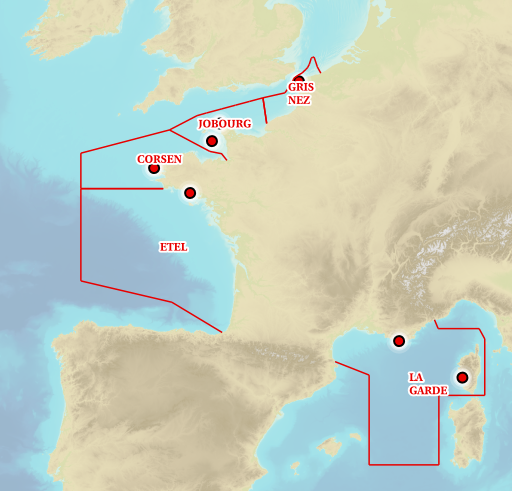
Information layer containing the SAR Zones (Search and Rescue). This layer contains a description of the French search and rescue (SAR) areas and the location of the associated Maritime Rescue Coordination Center (MRCC). it covers the areas of responsibility of France. The layer was produced by the Shom pursuant to the Circular Circular of the International Maritime Organization (IMO No. SAR.8 / Circ.4 of 1 December 2012).
-
In the Law of the Sea, a straight baseline is composed by a loxodrome connecting two points of the low-water line or low-tide elevations if there is a lighthouse or similar permanent infrastructure on them. The conditions to draw such lines are defined in Article 7 of UNCLOS. The straight baselines are part of the baselines of a coastal State below which the internal waters are defined. Those straight baselines, in addition with the normal baseline, compose the inner limit of the territorial sea and are the basis of the computations of the outer limits of other maritime spaces defined by UNCLOS. They are also composed of the closure line for bays and rivers in compliance with Aricles 9 and 10 of UNCLOS. The objects of the theme "Straight baselines" result from Shom computations and are published by decree of the French Republic.
-
In compliance with Article 33 of UNCLOS, the outer limit of the contiguous zone is located at 24 nautical miles from the baselines. The objects of the theme "Outer limit of the contiguous zone" result from Shom computations and are compliant with Article 10 of the French Order No 2016-1687 of 8 December 2016.
-
Title V of Volume IX of rural and sea fisheries laws defines the measures related to Overseas territories. Articles R951-14 and R953-5 in particular define for specific Overseas territories a limit located at 100 nautical miles from the in force baselines. Inside this limit, fisheries are limited to the ships registered in the ports of those Overseas territories, except dispensation allowed by State. Those restrictions are not applied to ships registered in the European Union which are traditionally fishing in those waters, as long as they do not exceed the fisheries effort which is traditionally applied.
-
The Regulation (EU) No 1380/2013 of European Parliament and Council of 11 December 2013, in its second paragraph of Article 5, authorises Member States to establish coastal waters along its coasts. Those areas enable member States to restrain fisheries to specific species to specific Member States following precise rules (quotas, limited fishery season). The description of the French coastal waters is established in Part 6 of Appendix 1. The coastal waters extend from 6 nautical miles from in force baselines to 12 nautical miles from in force baselines. Only portions of the French coasts are concerned.
-
The regulatory part of Volume IX of rural and sea fisheries laws is defined by the decree No 2014-1608 of 26 December 2014. In particular, Article D922-16 of the appendix to the decree defines a limit related to fisheries located at 3 nautical miles from the low waterline of the continent and islands and islets which are always dry. In the particular case of Mayotte Island, in compliance with Article 61 of the prefectural decree No 2018-681 of 30 July 2018 which regulates the exercise of sea fisheries at Mayotte department, this limits is located at 3 nautical miles from the in force baselines.