 Catalogue Shom
irregular
Type of resources
Available actions
Topics
Keywords
Provided by
Years
Formats
Representation types
Update frequencies
status
Scale
Resolution
-
The Tidal stream atlas netcdf product provides tidal current data for an area stretching from the French coast, covering The English Channel and the Bay of Biscay. The product consists of gridded files with different spatial resolutions. The U and V velocities of the tidal currents depend on the tidal conditions considered at mean neap and spring tidal rates. The data are provided in m/s for the surface layer. The times are given in relation to high tide at the reference port chosen in the area and are provided from 6 hours before to 6 hours after that reference.
-
The Tidal stream atlas netcdf product – The Channel provides tidal current data for an area stretching from the coast of Flanders east of Dunkirk to Brest. The product consists of a unique gridded file with 2 km spatial resolution covering the Channel. The U and V velocities of the tidal currents depend on the tidal conditions considered at mean neap and spring tidal rates. The data are provided in m/s for the surface layer. The times are given in relation to high tide at the reference port chosen in the area and are provided from 6 hours before to 6 hours after that reference.
-
The Tidal stream atlas netcdf product – Strait of Dover provides tidal current data for an area stretching from the coast of Flanders east of Dunkirk to Saint-Valery-en-Caux. The product consists of four gridded files with different spatial resolutions covering the Strait of Dover area (overall view at 500 m) and the geographical areas of the ports of Dunkirk (250 m), Calais (250 m) and Boulogne-sur-Mer (250 m). The U and V velocities of the tidal currents depend on the tidal conditions considered at mean neap and spring tidal rates. The data are provided in m/s for the surface layer. The times are given in relation to high tide at the reference port chosen in the area and are provided from 6 hours before to 6 hours after that reference.
-
The Tidal stream atlas netcdf product – Seine Bay provides tidal current data for an area stretching from Fecamp at the east of the area to Cherbourg at the west. The product consists of two gridded files with different spatial resolutions covering the Seine Bay area (overall view at 500 m) and the geographical area of Le Havre harbour (250 m). The U and V velocities of the tidal currents depend on the tidal conditions considered at mean neap and spring tidal rates. The data are provided in m/s for the surface layer. The times are given in relation to high tide or low tide at the reference port chosen in the area and are provided from 6 hours before to 6 hours after that reference.
-
The Tidal stream atlas netcdf product – Normand-Breton Gulf provides tidal current data for an area stretching from Cherbourg at the east of the area to Tregastel at the west. The product consists of a unique gridded file with 500 m spatial resolution covering the Normand-Breton Gulf, including The Channel Islands. The U and V velocities of the tidal currents depend on the tidal conditions considered at mean neap and spring tidal rates. The data are provided in m/s for the surface layer. The times are given in relation to high tide at the reference port chosen in the area and are provided from 6 hours before to 6 hours after that reference.
-

Bathymetric datasets are an extraction of surveys belonging to the Shom public database. For depth up to 50m, the vertical precision of soundings varies from 30cm to 1m and the horizontal precision varies from 1 to 20m. In deep ocean, the vertical precision is mainly around 1 or 2% of the bottom depth. It is sometimes more, it depends on the technology used. The data are referenced to ZH which is assimilated to LAT. Data are corrected for sound velocity variations. <br /> October 27 2025 version
-
This service allows users to view surface tidal current predictions calculated from the analysis of a high-resolution hydrodynamic simulation projected onto a 100 m grid. This service was built by Shom and funded by French CCI Métropolitaine Bretagne Ouest in the frame of the Atlantic Blue Port project of <a href="https://www.atlanticarea.eu" target="_blank">Interreg Atlantic Area</a> european program.
-

Bathymetric datasets are an extraction of surveys belonging to the Shom public database. For depth up to 50m, the vertical precision of soundings varies from 30cm to 1m and the horizontal precision varies from 1 to 20m. In deep ocean, the vertical precision is mainly around 1 or 2% of the bottom depth. It is sometimes more, it depends on the technology used. The data are referenced to ZH which is assimilated to LAT. Data are corrected for sound velocity variations. <br /> October 27 2025 version
-
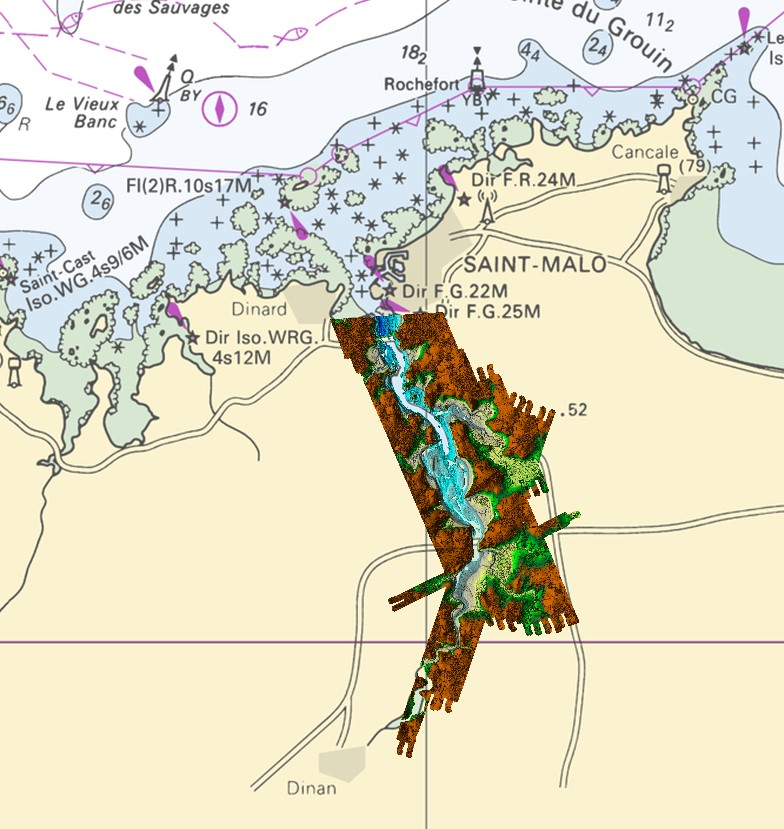
Lidar marine product is a unique and continuous land-sea database which can provide 3D models of the shape and location of french coastal terrain. Surveys are carried out by airborne lidar bathymetry over the sea side and airborne lidar topography over the land side up to 400m inland. This marine product is available in two formats: a set of 3D points and a qualified terrain mesh.
-
This service allows users to view surface tidal current predictions calculated from the analysis of a high-resolution hydrodynamic simulation projected onto a 30 m grid. This service was built by Shom and funded by French CCI Métropolitaine Bretagne Ouest in the frame of the Atlantic Blue Port project of <a href="https://www.atlanticarea.eu" target="_blank">Interreg Atlantic Area</a> european program.